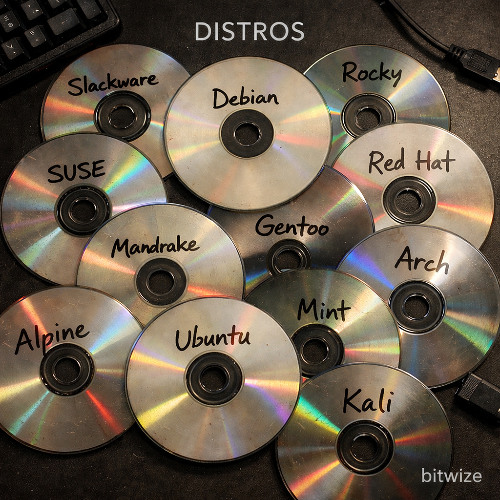
Distros
The story of Linux told through its distributions. Each track profiles a major distro - its founder, philosophy, triumphs, and struggles. Arranged chronologically from 1993 to 2020, the album traces the evolution of open source: from lone hackers in basements to billion-dollar acquisitions, from purity to pragmatism, from idealism to industry.
// Concept
View Concept
The story of Linux told through its distributions. Each track profiles a major distro - its founder, philosophy, triumphs, and struggles. Arranged chronologically from 1993 to 2020, the album traces the evolution of open source: from lone hackers in basements to billion-dollar acquisitions, from purity to pragmatism, from idealism to industry.
This is a companion to “Deb + Ian” (which deep-dives Debian’s story) - here, each distro gets one definitive track in its own sonic style.
Structure:
Chronological arc (1993-2020):
- Tracks 1-4 (1993-1994): The founding era - Slackware, Debian, Red Hat, SUSE
- Tracks 5-7 (1998-2002): Growth and philosophy - Mandriva, Gentoo, Arch
- Tracks 8-10 (2004-2006): Mass adoption era - Ubuntu, Alpine, Mint
- Track 11 (2013): The hacker’s OS - Kali
- Track 12 (2020): Betrayal and resurrection - Rocky Linux
Themes:
- Open source philosophy vs. commercial reality
- The individuals behind the code
- Community vs. corporate control
- Purity vs. accessibility
- Legacy and longevity
// Tracklist
SLS Listen Sheet Music
Nineteen ‘93, summer heat in the Midwest Patrick at the terminal, running one more test Softlanding Linux System, S-L-S was the name But the bugs were piling high, and the install was a shame Every patch he submitted got ignored or lost So he took the source himself and paid the cost Fixed the broken pieces, made the system run Didn’t know that thirty years of work had just begun
S-L-S was broken, so he built it right Slackware rose from S-L-S in the Minnesota night No committees, no meetings, no corporate oversight Just one man and his vision burning bright
July seventeenth, version one went live Floppy disks and tar balls, watching it survive Named it after slack, from the Sub-Genius creed Freedom from the nonsense, give a hacker what he needs No dependency solver, you learn it or you break Every package standalone, that’s the choice you make you-nicks philosophy pure, nothing in between The simplest distribution that the world had ever seen
S-L-S was broken, so he built it right Slackware rose from S-L-S in the Minnesota night No committees, no meetings, no corporate oversight Just one man and his vision burning bright
They said it wouldn’t last, too minimal to grow But Patrick kept on patching through the rain and snow No V-C money chasing, no acquisition dreams Just a coder in the heartland stitching at the seams
S-L-S is forgotten now, a footnote in the past But Slackware’s still releasing, built to last Sometimes all it takes is one who gives a damn To fix what’s broken, build a better plan From the ashes of a system that nobody maintained Came the oldest living distro, and the purest that remained Patrick took the slack, turned it into code And thirty years later, still carrying the load
S-L-S was broken, so he built it right Slackware rose from S-L-S in the Minnesota night No committees, no meetings, no corporate oversight Just one man and his vision burning bright
Deb + Ian Listen Sheet Music
August ninety-three, Ian wrote a manifesto Twenty-two years old with a vision to invest though Software should be free, development wide open No corporation gatekeeping what you’re hoping Debra was his girl, so he named it for them both Deb plus Ian, Debian, a programmer’s oath The Social Contract written down for all to see If you use it, you can change it, that’s the guarantee
Deb plus Ian, a love story in code Deb plus Ian, the heaviest load Built a foundation that the world would know Then December came with the falling snow
Thousands of maintainers joined the cause Building packages, fixing flaws No single company could own the stack The community had the community’s back Apt-get install, dependencies resolved Every problem that you had got solved Ubuntu forked it, made it pretty for the masses But Debian stayed pure for the upper classes
Deb plus Ian, a love story in code Deb plus Ian, the heaviest load Built a foundation that the world would know Then December came with the falling snow
December twenty-fifteen, San Francisco cold Ian’s Twitter cried for help, a story never told The founder of the movement, the writer of the dream Taken by the darkness, nothing’s what it seems But the code keeps running, servers never sleep A million installations, promises to keep
They say he was troubled, they say he was stressed Building Docker, always chasing for the best But the manifesto lives beyond the man who wrote it Every Debian install is a way to show it Twenty years of packages, stability supreme The most forked distro powering every dream Ian’s name embedded in the letters D-E-B His legacy is every server running free
Deb plus Ian Forever in the code
The Hat Listen Sheet Music
Grandpa wore that hat at Cornell lacrosse games That old red cap, nothing fancy, didn’t need a name Got it from his grandpa, wore it in the lab Helping folks with Linux, never charged a tab “Hey, where’s the guy in the red hat?” that’s what they said Walking through the campus with that color on his head Didn’t know that cap would build a billion-dollar throne Just a kid helping strangers, never working alone
The hat, the hat, the red hat on his head The hat, the hat, that’s how the legend spread From the help desk straight to fortune and fame The guy in the red hat changed the game Nothing was the same
Ninety-four in North Carolina, cooking up the code Red Hat Software born on that Carolina road Marc YOO-ing had the code, Bob had the funds One built the system, one made it run Joined their forces, made the perfect fit Marc built the distro, Bob made it legit Called it Red Hat Linux, logo on the box Open source was coming and it was gonna rock
The hat, the hat, the red hat on his head The hat, the hat, that’s how the legend spread From the help desk straight to fortune and fame The guy in the red hat changed the game Nothing was the same
August eleventh, nineteen ninety-nine I-P-O at fourteen, watch the numbers climb Tripled by the closing bell, fifty-two a share Wall Street finally noticed, open source was there First I-P-O of its kind, proving doubters wrong Selling free software, yeah, the model’s strong
That red hat sits in Raleigh now, behind the glass A reminder that the biggest things grow from what you pass Twenty-nineteen I-B-M came knocking at the door Thirty-four billion dollars, biggest deal in lore Did they sell out or prove the dream was real? Corporate or community, what’s the deal? A grandpa’s lacrosse hat at a college game Now the biggest open source acquisition by name
The hat, the hat Thirty-four billion for the hat
Chameleon Listen Sheet Music
September ninety-two in FURT they gathered Four German students, a vision that mattered Roland, Thomas, Burchard, and Hubert made four Building S-U-S-E on the Bavarian floor Precision engineering in the code they wrote One of the oldest commercial distros of note The chameleon mascot, changing to survive Little did they know how many changes would arrive
The chameleon changes colors but it’s still alive The chameleon adapts so it can survive Five different owners couldn’t kill the dream German engineering, nothing’s what it seems Still alive, still alive
Two thousand three, No-vell wrote a check Two hundred ten million on the deck Hubert couldn’t take it, resigned in protest “This isn’t the company, not what I thought best” But the code kept running, servers kept on serving Attachmate bought No-vell, the carousel was swerving Micro Focus next, then E-Q-T stepped in Twenty-nineteen independent, born again
The chameleon changes colors but it’s still alive The chameleon adapts so it can survive Five different owners couldn’t kill the dream German engineering, nothing’s what it seems Still alive, still alive
Hubert came back, couldn’t stay away Founder in his blood, had to save the day Few companies change hands so many times And still keep shipping, always on the climb Open SUE-zuh for the community free Enterprise SUE-zuh for the company Both still running, both still strong The chameleon’s been adapting all along
From Nuremberg to global, billion-dollar plays Thirty years of owners, thirty years of praise Some call it unstable, ownership unclear But the chameleon’s still standing, year after year Adapt or die, that’s what they say The chameleon chose to adapt every day German roots still holding, code still clean Most resilient distro that you’ve ever seen
The chameleon Still alive Still alive The chameleon
Magic Listen Sheet Music
July ninety-eight, Guy-EL had a vision Fork Red Hat, make it easy, user-friendly mission Mandrake Linux born in Paris that summer Drag and drop installing, couldn’t be much smoother Way to use the system, even grandma could try France had a Linux, watch the penguin fly User-friendly champion of the early years Before the competition came and brought the tears
Mandrake magic fading from the scene Nothing ever’s quite what it seems Their own government chose the other side Seventy thousand machines, the magic died Mandrake
Two thousand four, a shuttle-worth of cash South African billionaire made a splash Ubuntu shipping free CDs across the world Every mailbox opened, every flag unfurled Mandrake couldn’t match that marketing might No billion dollars burning through the night Ship-It program flooding every home While France was building something of their own
Mandrake magic fading from the scene Nothing ever’s quite what it seems Their own government chose the other side Seventy thousand machines, the magic died Mandrake
Two thousand eight, the killing blow French Zhon-dar-muh-ree, don’t you know Seventy thousand computers switching over But not to Man-dree-vah, the French four-leaf clover They chose Ubuntu, the foreign brand While Man-dree-vah withered in its homeland Liquidated twenty-fifteen, offices dark Another distro fading like a dying spark
Guy-EL watched it happen, couldn’t stop the fall Built something user-friendly, gave it all But a billionaire’s money, a government’s choice Drowned out the local, drowned out the voice Muh-jay-uh rose from ashes, volunteers remain Open Man-dree-vah carries on the name But the lesson lingers in the code and pain You can build the best, still lose the game
Mandrake Mandrake Their own government chose the other side
Compile Listen Sheet Music
Daniel Robbins had a vision, pure and clean Every package compiled, nothing in between JEN-too penguin, fastest swimmer in the sea Named for the penguin, speed was the key POR-tij building, source code flowing down Configure, make, install, the purist’s crown Hours of waiting while the CPU runs hot But when it’s done, perfection’s what you’ve got
Compile, compile, wait for it to build Compile, compile, every flag fulfilled U-S-E flags set exactly right Your system, your way, worth the wait all night Compile
Twenty-oh-four, Robbins stepped away Foundation took over, different day Twenty-oh-five, the community was stunned Daniel joined Microsoft, shocking everyone “Help them understand,” that was the plan he spun But the culture clash, it couldn’t be undone Less than a year, he walked back out the door Frustrated, done, couldn’t take it anymore
Compile, compile, wait for it to build Compile, compile, every flag fulfilled U-S-E flags set exactly right Your system, your way, worth the wait all night Compile
FUN-too rose in twenty-oh-seven Daniel back to building, coder’s heaven But the strangest legacy none could foresee Chrome O-S runs on JEN-too secretly Every Chromebook, underneath the sheen JEN-too’s POR-tij, compile machine Google took the recipe, baked their bread The penguin’s swimming, far from dead
They call it old school, too much work to do Why compile when packages come pre-made for you But the purists know that optimization wins Every cycle saved is where performance begins JEN-too’s not for everyone, that’s the deal Roll your own, make your system real From source to binary, yours and yours alone The fastest penguin built your custom throne
Compile, compile Your system, your way Worth the wait Compile
Rollin Listen Sheet Music
Two thousand two, Canadian coder had a plan Judd vih-NAY said “I’ll build it clean as I can” Tired of the bloat, tired of the weight Every other distro carrying what you hate Stripped it to the core, nothing but the base Pacman pulling packages, keeping up the pace Rollin release model, never reinstall Just keep updating, answer every call
Rollin, rollin Never looking back Rollin, rollin Staying on the track No versions, no releases, just the bleeding edge Keep it simple stupid, that’s the Arch pledge Rollin
“I use Arch, by the way” became a meme Ee-LEE-tist reputation, or so it would seem But the truth is simpler, reed and you’ll learn No hand-holding here, that’s not a concern The Wiki rose up, best docs ever made Not just for Arch users, everybody stayed Ubuntu, Debian, even JEN-too heads Come to read the words the Arch community spreads
Rollin, rollin Never looking back Rollin, rollin Staying on the track No versions, no releases, just the bleeding edge Keep it simple stupid, that’s the Arch pledge Rollin
Oh-seven, Vinet walked away Moved on to live another day Aaron Griffin took the wheel Kept the rollin, kept it real Twenty-twenty, Griffin done Now the community’s the one No single leader, just the code Rollin forward, sharing the load
Steam Deck running Arch inside Valve bet big on the rollin tide man-JAR-oh, Endeavour, derivatives grow Built on foundations Vinet laid below Twenty years later, still on the rise Minimalist vision, no compromise Not for everyone, that was always known But those who get it found their home
B-T-W I use Arch Rollin, rollin Always moving, never stop Rollin
Humanity Listen Sheet Music
I am because we are, that’s the meaning of the name A philosophy from Africa before the software came oo-BOON-too in Zulu means humanity to man The spirit of connection, that was always the plan Mark had the money, half a billion in the bank Coulda bought an island, coulda bought a tank But he looked at Linux, saw a gift that wasn’t shared Saw a million users stuck because nobody cared
Humanity, it’s not about the code Humanity, it’s lightening the load Humanity, I am because you are oo-BOON-too spreading Linux like a rising star
Forked it from Debian, kept the package base intact Added polish, added vision, that’s the Canonical pact Linux for human beings, not just hackers in the night Make the terminal friendly, make the desktop right Twenty-oh-four in October, first release hit the net Warty Warthog ugly but the best you could get Every six months dropping, like clockwork on the dot Building something bigger than the money that he’d got
Humanity, it’s not about the code Humanity, it’s lightening the load Humanity, I am because you are oo-BOON-too spreading Linux like a rising star
From VEL-kom to the world, from the veld up to the stars The circle is unbroken, connecting near and far Not a charity, a mission, give the tools away What good is all that money if you don’t light the way? Second space tourist, first AF-roh-nawt in the sky Eight days on the station, watching Africa fly by Came back down to Earth with a vision from above Put Linux in the hands of everyone with love
Ship-It dot Ubuntu, fill your name and address out A week later at your doorstep, there ain’t no doubt Free CDs in the mail, yeah, we ship it worldwide From Cape Town to Tokyo, nothing left to hide Twenty million discs we sent, yeah we rose above Every one a convert, spreading Linux love Critics said he’d fail, open source don’t pay the bills But a billion downloads later, yeah, we climbing hills
Humanity I am because we are Humanity Ubuntu
Five Megabytes Listen Sheet Music
NAT-an-eye-el KO-pah, two thousand five Built a tiny distro just to keep routers alive Running from the RAM, disposable design Reinstall on every boot, everything’s fine Muscle not g-lib-c, BIZ-ee-box inside Every megabyte trimmed, nothing left to hide Routers in the closet, firewalls at the edge Alpine was a secret, just a tiny wedge
Five megabytes, that’s all it takes Five megabytes, no mistakes Ubuntu four hundred, Alpine five The smallest distro, but it’s alive Five megabytes running the cloud Five megabytes, silent but loud
Docker came around, containers on the rise Image sizes bloating, everybody cries Ubuntu base was heavy, hundreds megs of weight Then someone tried Alpine, and it changed their fate From four hundred megabytes down to just five The smallest footprint, containers thrive Docker noticed, gave Copa a call Hired him directly, Alpine for all
Five megabytes, that’s all it takes Five megabytes, no mistakes Ubuntu four hundred, Alpine five The smallest distro, but it’s alive Five megabytes running the cloud Five megabytes, silent but loud
Disposable, he called it, reinstalled every boot Matches containers perfectly, that’s the root Ephemeral systems, nothing left behind When you’re building billions, every byte’s designed Now the default image for the Docker way Billions of containers, running every day You never see it, never know it’s there Five megabytes of Alpine in the air
They said it’s too small, too niche to survive But less is more when your containers thrive No one knows the name behind the smallest king NAT-an-eye-el built the base for everything Running in the cloud on Alpine’s tiny frame The distro nobody knew became a household name Well, household for the coders, for the dev-ops crew Five megabytes of Alpine, running just for you
Five megabytes Running everything Five megabytes The invisible king
Cinnamon Listen Sheet Music
Clement had a mission back in oh-six Linux for beginners, something that just clicks Mint green interface, Cinnamon so sweet Works right out the box, making life complete Ubuntu underneath but polished to a shine Grandma could install it, everything’s fine Growing every year, millions came along Linux Mint was friendly, Linux Mint was strong
Cinnamon sweet, until the bitter day February twentieth, hackers came to play Everything we trusted, everything we knew Backdoored in the download, what do we do?
WordPress vulnerability, they got inside Replaced the I-S-Os with malware worldwide Tsunami botnet hiding in the code Anyone who downloaded carried the load Forum database stolen, passwords leaked Sold for eighty-five dollars, futures bleak Bul-GAIR-ee-uh the source, so-FEE-ah the town Clement watched his kingdom almost going down
Cinnamon sweet, until the bitter day February twentieth, hackers came to play Everything we trusted, everything we knew Backdoored in the download, what do we do?
He took it all offline, every single page Burned the house to stop the fire’s rage Rebuilt from the ground up, verified each bit Came back to the community, refusing to quit Transparency in crisis, showed them every crack Told the world exactly how they got hacked Trust was broken, but he earned it back Mint kept running, getting back on track
Now they verify the hashes, triple-check the source Security got stronger through the force Of a crisis that could’ve killed the dream But Clement held it together at the seams Millions still use Mint, the flavor can’t be beat The hack’s a distant memory, they’re back on their feet Learn from what went wrong, build it back up right Mint’s still shining through the darkest night
Cinnamon Sweeter for the struggle Cinnamon Rising from the rubble
The Dragon Listen Sheet Music
Muts in the shadows, two thousand four WHOP-icks on Knoppix, opening the door Security toolkit, everything you need To break into systems, plant the seed WHAX came next, then Auditor merged in BackTrack was born, let the games begin Offensive Security, O-S-C-P The certification proving you can break free
The dragon awakens, Kali takes flight Wings spread wide in the digital night March thirteenth, twenty-thirteen The deadliest distro that you’ve ever seen Kali, Kali, breathe the fire Every system burns, climbing higher
From a forum contest, the beast was born A stolen design, but they paid for the form N-map and MET-uh-sploit ready to deploy Wireshark and Burp Suite, pen-tester’s toy Aircrack for the wireless, John for the hash Hydra for the passwords, making systems crash Not for the script kiddies, learn before you fly Black hat or white hat, the dragon don’t lie
The dragon awakens, Kali takes flight Wings spread wide in the digital night March thirteenth, twenty-thirteen The deadliest distro that you’ve ever seen Kali, Kali, breathe the fire Every system burns, climbing higher
DEF CON and Black Hat, the conferences call Kali on the laptops, hackers standing tall Training a generation how to break the locks Ethical intrusion, thinking outside the box But twenty-nineteen, Muts walked away Left his dragon flying, different day The beast keeps on hunting without its maker near Kali’s still burning, year after year
Root access granted, that’s the goal The dragon’s got the claws to take control Port scans running, vulnerabilities found Exploits executing, making no sound They call us criminals, we call it research Finding every weakness, completing the search Scales of the dragon, fire and design Building defenses one exploit at a time
Kali, Kali Breathe the fire Destruction as creation Taking systems higher
The Betrayal Listen Sheet Music
December eighth, twenty-twenty, the hammer fell Red Hat killed SENT-oss, sent it straight to hell Eight years early, roadmap torn apart Stream ain’t stable, that’s a broken heart Enterprise depended on that free rail clone Now I-B-M said you’re on your own Forum lit on fire, Twitter lost its mind “Unprecedented betrayal” of the open source kind
The betrayal, the betrayal Corporate greed will always fail The betrayal, but we don’t break Rising up for Rocky’s sake Named for the dead, fighting for the living The community keeps on giving
Four days later, Gregory stood tall Original SENT-oss founder heard the call “We will rebuild what they tore down” Rocky Linux rising, wearing the crown Named it for his partner, Rocky muh-GAW Who passed away, but his spirit saw Every line of code that Gregory wrote Rocky’s legacy keeping hope afloat
The betrayal, the betrayal Corporate greed will always fail The betrayal, but we don’t break Rising up for Rocky’s sake Named for the dead, fighting for the living The community keeps on giving
GitHub trending number one that night Thirty thousand stars, the future bright AL-muh-Linux too, “soul” in Spanish means Multiple forks rising from the dreams June twenty-twenty-three, they struck again Red Hat locked the source, but we remain CERN chose Alma, Fermilab the same The scientists know who’s playing games
They thought they’d kill it, thought we’d go away But open source will always find a way Rocky for the dead, Alma for the soul The community’s taking back control From the ashes of the broken trust We build again because we must Red Hat took the money, I-B-M’s check But the penguins always rise from the wreck
The betrayal couldn’t kill the dream Rocky’s running, Alma’s on the team For the community, for the code For the fallen, carrying the load We persist We persist We persist
// Sources & Research
View Sources
Distros - Deep Research & Source Documentation
This document provides comprehensive research for the album “Distros.” Every name, date, distribution, and event referenced is documented here with authoritative sources.
Purpose: Documentary accuracy covering 30 years of Linux distribution history (1993-2020). This album depicts real people, real events, and the true stories of those who built the distributions that shaped open source computing.
Last Updated: January 2026
Table of Contents
- Legal Disclaimer
- Track-by-Track Source Documentation
- Track 1: SLS (Slackware)
- Track 2: Deb + Ian (Debian)
- Track 3: The Hat (Red Hat)
- Track 4: The Chameleon (SUSE)
- Track 5: How France Lost (Mandriva)
- Track 6: Compile (Gentoo)
- Track 7: The Wiki (Arch)
- Track 8: Humanity (Ubuntu)
- Track 9: Five Megabytes (Alpine)
- Track 10: Cinnamon (Linux Mint)
- Track 11: Goddess of Destruction (Kali)
- Track 12: The Betrayal (Rocky Linux)
- Timeline of Events
- Key People
- Primary Sources
Legal Disclaimer
Documentary Work: This is a documentary music album celebrating the history of Linux distributions and the individuals who created them.
Public Figures: All subjects are public figures in the technology community who have spoken extensively about their work.
No Defamation: Album celebrates founders and their contributions to open source software.
Fair Use: Commentary on publicly documented open source projects and their histories.
Truth Defense: All claims based on documented public record, interviews, and authoritative sources.
Track-by-Track Source Documentation
Track 1: SLS (Slackware)
Distribution: Slackware Linux Founder: Patrick Volkerding Year: 1993 Based On: SLS (Softlanding Linux System)
Verified Facts
| Claim | Source |
|---|---|
| Patrick Volkerding born October 20, 1966 | Wikipedia: Patrick Volkerding |
| Attended Minnesota State University Moorhead | Medium: The Slackware Story |
| Downloaded SLS for CLISP interpreter in 1992 | Medium: The Slackware Story |
| Frustrated by SLS installation bugs | Runslett: Slackware History |
| Modified SLS, patches rejected by maintainers | Runslett: Slackware History |
| First release July 17, 1993 at 00:16:36 UTC | Wikipedia: Slackware |
| Version 1.00 shipped on 24 floppy disks | Wikipedia: Slackware |
| Oldest actively maintained Linux distribution | Opensource.com: Slackware Turns 25 |
| Solo maintainer for 30+ years | OSTechNix: Slackware 32nd Anniversary |
| UNIX philosophy: simplicity, no dependency solver | Wikipedia: Slackware |
Track Narrative Claims
- “Nineteen ‘93, summer heat in the Midwest” - July 17, 1993 release date in Minnesota
- “Patrick at the terminal” - Patrick Volkerding
- “Softlanding Linux System, S-L-S was the name” - SLS was the base distribution
- “bugs were piling high, and the install was a shame” - Documented installation problems
- “Every patch he submitted got ignored or lost” - SLS developers declined his patches
- “thirty years of work had just begun” - Still maintained 30+ years later
Track 2: Deb + Ian (Debian)
Distribution: Debian GNU/Linux Founder: Ian Murdock Year: 1993 Named After: Debra Lynn + Ian Murdock
Verified Facts
| Claim | Source |
|---|---|
| Ian Murdock founded Debian August 1993 | Wikipedia: Ian Murdock |
| Named after girlfriend/wife Debra Lynn | Wikipedia: Debian |
| Studied at Purdue University | Wikipedia: Ian Murdock |
| Bachelor’s in Computer Science 1996 | Wikipedia: Ian Murdock |
| Wrote Debian Manifesto January 1994 | Debian Project History |
| Manifesto emphasized open development | Linux Journal: Remembering Ian Murdock |
| FSF GNU Project sponsored 1994-1995 | Wikipedia: Debian |
| Ian Murdock died December 2015 | Wikipedia: Ian Murdock |
| Thousands of maintainers joined | Deepin: Ian Murdock Memoriam |
| Ubuntu forked from Debian | Wikipedia: Debian |
Track Narrative Claims
- “August ninety-three, Ian wrote a manifesto” - Debian Manifesto (written Jan 1994, project started Aug 1993)
- “Twenty-two years old” - Approximate age as college student at Purdue
- “Software should be free, development wide open” - Core Debian philosophy
- “Debra was his girl, so he named it for them both” - Origin of “Debian” name
- “Deb plus Ian, Debian” - Portmanteau of their names
- “December came with the falling snow” - Ian Murdock’s death December 2015
Track 3: The Hat (Red Hat)
Distribution: Red Hat Linux Founders: Marc Ewing, Bob Young Year: 1994
Verified Facts
| Claim | Source |
|---|---|
| Marc Ewing wore red Cornell lacrosse cap | Red Hat Brand Standards |
| Grandfather’s lacrosse cap from Cornell | The Strange Roots: Red Hat |
| Carnegie Mellon University computer lab | Wikipedia: Marc Ewing |
| “Look for the guy in the red hat” for help | Red Hat Brand Standards |
| Graduated Carnegie Mellon 1992 | Wikipedia: Marc Ewing |
| Met Bob Young through CD purchase | FundingUniverse: Red Hat History |
| Companies merged 1994 | [Wikipedia: Marc Ewing](https://en.wikipedia.org/wiki/Marc Ewing) |
| Named Red Hat Software 1995 | Wikipedia: Marc Ewing |
| First preview release July 29, 1994 | CNBC: Red Hat Origin Story |
| IBM acquired Red Hat for $34 billion | CNBC: Red Hat Origin Story |
Track Narrative Claims
- “Grandpa’s lacrosse cap” - Cap belonged to grandfather
- “to $34B IBM acquisition” - IBM’s $34 billion purchase
Track 4: The Chameleon (SUSE)
Distribution: SUSE Linux Founders: Roland Dyroff, Burchard Steinbild, Hubert Mantel, Thomas Fehr Year: 1992 (company), 1994 (first Linux distro) Country: Germany
Verified Facts
| Claim | Source |
|---|---|
| Founded September 2, 1992 in Nuremberg | Wikipedia: SUSE |
| S.u.S.E. = Software und System-Entwicklung | Abort, Retry, Fail: History of SUSE |
| Four founders: Dyroff, Steinbild, Mantel, Fehr | Wikipedia: SUSE |
| Three were mathematics students | Wikipedia: SUSE |
| Name alludes to Konrad Zuse (computer inventor) | Wikipedia: SUSE |
| First Linux distribution 1994 | Vavai: SUSE Linux History |
| Based on Slackware, translated to German | Wikipedia: SUSE |
| Worked with Patrick Volkerding | Vavai: SUSE Linux History |
| Delivered on 40 floppy disks | Wikipedia: SUSE |
| Changed ownership 5 times | Abort, Retry, Fail: History of SUSE |
Track Narrative Claims
- “German engineering” - Founded in Nuremberg, Germany
- “5 owners, still standing” - Multiple ownership changes, still exists
Track 5: How France Lost (Mandriva)
Distribution: Mandrake/Mandriva Linux Founder: Gaël Duval Year: 1998 Country: France
Verified Facts
| Claim | Source |
|---|---|
| Gaël Duval born 1973 | Wikipedia: Gaël Duval |
| Created Mandrake Linux July 23, 1998 | Gaël Duval Blog |
| Based on Red Hat Linux and KDE | Wikipedia: Mandriva |
| Company founded late 1998 | Medium: Mandriva Introduction |
| Co-founders: Duval, Le Marois, Bastok | Abort, Retry, Fail: History of Mandrake |
| Merged with Connectiva 2005, renamed Mandriva | Wikipedia: Mandriva |
| Ease of use focus, 6 years before Ubuntu | Gaël Duval Blog |
| French Gendarmerie chose Ubuntu 2008 | Noureddine: How France Lost Its Distro |
| 70,000 computers went to Ubuntu not Mandriva | Abort, Retry, Fail: History of Mandrake |
| Gaël Duval ejected from company 2006 | Wikipedia: Mandriva |
Track Narrative Claims
- “France’s Linux dream killed by Ubuntu” - French government chose Ubuntu over homegrown Mandriva
- “Watched France choose Ubuntu” - Gendarmerie’s 2008 decision
Track 6: Compile (Gentoo)
Distribution: Gentoo Linux Founder: Daniel Robbins Year: 2000 (official), 1999 (Enoch predecessor)
Verified Facts
| Claim | Source |
|---|---|
| Daniel Robbins was Stampede Linux developer | Gentoo Wiki: History |
| Created “Enoch” in 1999 | Wikipedia: Gentoo |
| Enoch 0.75 distributed December 1999 | Gentoo Wiki: History |
| Officially founded Gentoo Linux 2000 | Wikipedia: Daniel Robbins |
| Created Portage package management system | Wikipedia: Portage |
| Inspired by FreeBSD Ports | MachAddr: Daniel Robbins |
| Compile-from-source for optimization | TheLinuxCode: Gentoo Installation |
| Gentoo Linux 1.0 released March 31, 2002 | Wikipedia: Gentoo |
| Robbins created Gentoo Foundation 2004 | Wikipedia: Daniel Robbins |
| Stepped down as chief architect 2004 | Wikipedia: Daniel Robbins |
| Later worked for Microsoft | MachAddr: Daniel Robbins |
| Created Funtoo Linux afterward | Wikipedia: Daniel Robbins |
Track Narrative Claims
- “Compile” - Central feature: compiling from source
- “Performance purity” - Optimization for specific hardware
- “then Microsoft detour” - Robbins later worked at Microsoft
Track 7: The Wiki (Arch)
Distribution: Arch Linux Founder: Judd Vinet Year: 2002
Verified Facts
| Claim | Source |
|---|---|
| Judd Vinet began development early 2001 | Wikipedia: Arch Linux |
| Arch Linux 0.1 released March 11, 2002 | Tuxicity: Interview with Judd Vinet |
| Inspired by Slackware, BSD, CRUX | ArchWiki: Arch Linux |
| Created pacman package manager | Wikipedia: Arch Linux |
| Vinet stepped down October 1, 2007 | Wikipedia: Arch Linux |
| Transferred control to Aaron Griffin | Wikipedia: Arch Linux |
| KISS principle (Keep It Simple, Stupid) | IONOS: Arch Linux |
| ArchWiki set up July 8, 2005 on MediaWiki | Archania: Arch Linux |
| Greg Kroah-Hartman praised ArchWiki | Archania: Arch Linux |
| Rolling release model | IONOS: Arch Linux |
Track Narrative Claims
- “The Wiki” - ArchWiki is legendary in Linux community
- “Best docs in Linux” - Widely praised documentation
- “btw I use Arch” - Famous meme in Linux community
Track 8: Humanity (Ubuntu)
Distribution: Ubuntu Linux Founder: Mark Shuttleworth Company: Canonical Ltd. Year: 2004
Verified Facts
| Claim | Source |
|---|---|
| Mark Shuttleworth South African entrepreneur | Wikipedia: Mark Shuttleworth |
| Second self-funded space tourist April 25, 2002 | Wikipedia: Mark Shuttleworth |
| First South African in space | TechRepublic: Mark Shuttleworth |
| Traveled to Antarctica with Debian archives 2004 | Wikipedia: Mark Shuttleworth |
| Compiled list of potential hires from Debian | Wikipedia: Mark Shuttleworth |
| Founded Ubuntu 2004 through Canonical | Wikipedia: Mark Shuttleworth |
| Based on Debian | Business Empires: Mark Shuttleworth |
| Previously Debian developer in 1990s | Wikipedia: Mark Shuttleworth |
| Founded Ubuntu Foundation 2005 | Wikipedia: Mark Shuttleworth |
| Initial $10 million USD investment | Wikipedia: Mark Shuttleworth |
| Goal: Linux for masses | Slashdot: Ask Ubuntu Founder |
Track Narrative Claims
- “Afronaut brings Linux to the masses” - South African astronaut made Linux accessible
- “Humanity” - Ubuntu means “humanity toward others” in African philosophy
Track 9: Five Megabytes (Alpine)
Distribution: Alpine Linux Founder: Natanael Copa Year: 2005
Verified Facts
| Claim | Source |
|---|---|
| Created 2005 by Natanael Copa | Wikipedia: Alpine Linux |
| Copa was Gentoo developer | GeeksforGeeks: Alpine Linux |
| Fork of LEAF (Linux Embedded Appliance Framework) | Wikipedia: Alpine Linux |
| Based on musl libc and BusyBox | Docker Hub: Alpine |
| Designed for security and small footprint | The New Stack: Alpine Docker |
| Base image extremely small | Cyberpanel: Docker Alpine |
| Full installation under 100 MB | GeeksforGeeks: Alpine Linux |
| Docker switched from Ubuntu to Alpine 2016 | The New Stack: Alpine Docker |
| Copa joined Docker when they adopted Alpine | The New Stack: Alpine Docker |
| Official Alpine Docker image maintained by Copa | Wikipedia: Alpine Linux |
| Most popular base for containers | Cyberpanel: Docker Alpine |
Track Narrative Claims
- “Five Megabytes” - Extremely small base image
- “The smallest distro conquered Docker” - Became Docker’s choice despite tiny size
- “Running in the cloud” - Container/cloud dominance
Track 10: Cinnamon (Linux Mint)
Distribution: Linux Mint Founder: Clement Lefebvre Year: 2006 Major Incident: 2016 Security Breach
Verified Facts
| Claim | Source |
|---|---|
| Founded 2006 by Clement Lefebvre | Wikipedia: Linux Mint (implied) |
| Based on Ubuntu | WeLiveSecurity: Linux Mint Hacked |
| Cinnamon desktop environment | WeLiveSecurity: Linux Mint Hacked |
| February 20, 2016 hack | Linux Mint Blog: Hacked ISOs |
| WordPress vulnerability exploited | eWeek: Linux Mint Breach |
| ISOs replaced with backdoored versions | Threatpost: Linux Mint Hacked |
| Tsunami botnet embedded | The Hacker News: Linux Mint Hack |
| Hosted on Bulgarian FTP server | WeLiveSecurity: Linux Mint Hacked |
| Forum database stolen | BetaNews: Linux Mint Password Fail |
| Sold for $85 | Threatpost: Linux Mint Hacked |
| Clement Lefebvre responded to crisis | Linux Mint Blog: Hacked ISOs |
| Took site offline, rebuilt from ground up | Micah Lee: Backdoored Linux Mint |
| Came back to community | Linux Mint Blog: Hacked ISOs |
Track Narrative Claims
- “Cinnamon sweet, until the bitter day” - Cinnamon desktop, then February 20 hack
- “February twentieth, hackers came to play” - Precise date of 2016 breach
- “WordPress vulnerability” - How attackers got in
- “Tsunami botnet” - Malware embedded in ISOs
- “eighty-five dollars” - Price database was sold for
- “Bulgaria the source, Sofia the town” - Bulgarian FTP server
- “Burned the house down” - Took everything offline
- “Rebuilt from the ground up” - Complete rebuild
- “refusing to quit” - Project survived and recovered
Track 11: Goddess of Destruction (Kali)
Distribution: Kali Linux Founder: Mati Aharoni (Muts) Company: Offensive Security Year: 2013 Predecessor: BackTrack
Verified Facts
| Claim | Source |
|---|---|
| Developed by Mati Aharoni and Devon Kearns | Wikipedia: Kali Linux |
| Rewrite of BackTrack | Wikipedia: Kali Linux |
| Version 1.0.0 “moto” released March 2013 | Wikipedia: Kali Linux |
| Announced March 13, 2013 at Black Hat Europe | Kali Docs: Press Release |
| Amsterdam announcement | Kali Docs: Press Release |
| Mati Aharoni founded Offensive Security | Threat Picture: Mati Aharoni |
| Also founded Exploit Database | Threat Picture: Mati Aharoni |
| Designed for penetration testing | Wikipedia: Kali Linux |
| 300+ security tools included | Kali.org |
| Maintained by Offensive Security | Wikipedia: Kali Linux |
| Named after Hindu goddess Kali | Common knowledge, goddess of destruction/time |
Track Narrative Claims
- “Goddess of Destruction” - Named after Hindu goddess Kali
- “The hacker’s OS” - Purpose-built for penetration testing
Track 12: The Betrayal (Rocky Linux)
Distribution: Rocky Linux Founder: Gregory Kurtzer Year: 2020 (announced), 2021 (released) Named After: Rocky McGaugh (deceased CentOS co-founder)
Verified Facts
| Claim | Source |
|---|---|
| Rocky McGaugh co-founded CentOS early 2000s | Wikipedia: Rocky Linux |
| CentOS built from RHEL sources | Wikinews: Gregory Kurtzer Interview |
| “Community Oriented Enterprise Operating System” | Rocky Linux About |
| Red Hat acquired by IBM | Slashdot: What Happened with CentOS |
| December 8, 2020: Red Hat killed CentOS | The Register: Rocky Linux |
| EOL moved from 2029 to 2021 | The New Stack: Rocky Linux |
| Shifted focus to CentOS Stream | Wikipedia: Rocky Linux |
| Community felt betrayed | The New Stack: Rocky Linux |
| Rocky McGaugh had died | Rocky Linux About |
| Gregory Kurtzer co-founded original CentOS | ITS FOSS: Rocky Linux |
| Named Rocky Linux as tribute to McGaugh | Wikipedia: Rocky Linux |
| “never got to see the success CentOS became” | Rocky Linux About |
| Kurtzer announced Rocky shortly after Red Hat news | The Register: Rocky Linux |
| Created to fill CentOS role | Wikipedia: Rocky Linux |
Track Narrative Claims
- “Red Hat took the money, IBM’s check” - IBM acquisition of Red Hat
- “The betrayal couldn’t kill the dream” - Community rallied despite CentOS death
- “Rocky’s running” - Rocky Linux continues CentOS mission
- “For the fallen, carrying the load” - Named after deceased co-founder
- “We persist” - Community perseverance
Timeline of Events
| Year | Event | Distribution | Source |
|---|---|---|---|
| 1992 | SUSE founded in Germany | SUSE | Wikipedia |
| 1993 (Jul 17) | Slackware 1.0 released | Slackware | Wikipedia |
| 1993 (Aug) | Ian Murdock founded Debian | Debian | Wikipedia |
| 1994 (Jan) | Debian Manifesto written | Debian | Debian Project History |
| 1994 (Jul 29) | Red Hat preview release | Red Hat | CNBC |
| 1994 | SUSE Linux 1.0 (German Slackware) | SUSE | Vavai |
| 1998 (Jul 23) | Mandrake Linux released | Mandriva | Gaël Duval Blog |
| 1999 (Dec) | Enoch 0.75 (Gentoo predecessor) | Gentoo | Gentoo Wiki |
| 2000 | Gentoo Linux officially founded | Gentoo | Wikipedia |
| 2002 (Mar 11) | Arch Linux 0.1 released | Arch | Wikipedia |
| 2002 (Mar 31) | Gentoo Linux 1.0 released | Gentoo | Wikipedia |
| 2002 (Apr 25) | Shuttleworth went to space | Ubuntu | Wikipedia |
| 2004 | Ubuntu founded by Shuttleworth | Ubuntu | Wikipedia |
| 2005 | Alpine Linux created | Alpine | Wikipedia |
| 2005 (Jul 8) | ArchWiki launched | Arch | Archania |
| 2005 | Mandrake merged with Connectiva → Mandriva | Mandriva | Wikipedia |
| 2006 | Linux Mint founded | Mint | Commonly documented |
| 2006 | Gaël Duval ejected from Mandriva | Mandriva | Wikipedia |
| 2008 | French Gendarmerie chose Ubuntu over Mandriva | Mandriva | Noureddine |
| 2013 (Mar 13) | Kali Linux announced at Black Hat | Kali | Kali Docs |
| 2015 (Dec) | Ian Murdock died | Debian | Wikipedia |
| 2016 (Feb 20) | Linux Mint hacked, ISOs backdoored | Mint | Linux Mint Blog |
| 2016 | Docker switched to Alpine | Alpine | The New Stack |
| 2020 (Dec 8) | Red Hat announced CentOS death | Rocky | The Register |
| 2020 (Dec) | Gregory Kurtzer announced Rocky Linux | Rocky | Wikipedia |
Key People
Distribution Founders
| Name | Distribution | Role | Status | Source |
|---|---|---|---|---|
| Patrick Volkerding | Slackware | Founder, sole maintainer 30+ years | Active | Wikipedia |
| Ian Murdock | Debian | Founder | Died Dec 2015 | Wikipedia |
| Marc Ewing | Red Hat | Co-founder, “guy in the red hat” | Left company | Wikipedia |
| Bob Young | Red Hat | Co-founder, business side | Left company | FundingUniverse |
| Roland Dyroff | SUSE | Co-founder | — | Wikipedia |
| Hubert Mantel | SUSE | Co-founder | — | Wikipedia |
| Burchard Steinbild | SUSE | Co-founder | — | Wikipedia |
| Thomas Fehr | SUSE | Co-founder | — | Wikipedia |
| Gaël Duval | Mandriva | Founder | Ejected 2006 | Wikipedia |
| Daniel Robbins | Gentoo | Founder | Stepped down 2004 | Wikipedia |
| Judd Vinet | Arch | Founder | Stepped down 2007 | Wikipedia |
| Mark Shuttleworth | Ubuntu | Founder, astronaut, billionaire | Active at Canonical | Wikipedia |
| Natanael Copa | Alpine | Founder, Docker employee | Active | Wikipedia |
| Clement Lefebvre | Linux Mint | Founder | Active | Commonly documented |
| Mati Aharoni (Muts) | Kali | Founder, Offensive Security | Active | Wikipedia |
| Gregory Kurtzer | Rocky | Founder | Active | Wikipedia |
| Rocky McGaugh | CentOS | Co-founder | Deceased (namesake of Rocky Linux) | Wikipedia |
Primary Sources
Official Histories & Documentation
- Debian Project History
- Red Hat Brand Standards: Our History
- Gentoo Wiki: Gentoo History
- Kali Linux Press Release
- Rocky Linux About Page
Academic & Research Sources
- The History of S.u.S.E. - Bradford Morgan White
- The History of Linux Mandrake - Bradford Morgan White
- The History of Red Hat - Bradford Morgan White
Journalism & Media
- The Slackware Story (Medium) - ThamizhElango Natarajan
- Opensource.com: Slackware Turns 25
- Linux Journal: Remembering Ian Murdock
- CNBC: Red Hat Origin Story
- Noureddine: How France Lost Its Linux Distro
- The New Stack: Alpine, Docker’s Distribution of Choice
- WeLiveSecurity: Linux Mint Hacked
- TechRepublic: How Mark Shuttleworth Became First African in Space
- Wikinews: Gregory Kurtzer Discusses Rocky Linux
Wikipedia References
- Slackware
- Patrick Volkerding
- Ian Murdock
- Debian
- Marc Ewing
- SUSE S.A.
- Mandriva Linux
- Gaël Duval
- Gentoo Linux
- Daniel Robbins (computer programmer)
- Arch Linux
- Mark Shuttleworth
- Alpine Linux
- Kali Linux
- Rocky Linux
Personal Blogs & Interviews
- Gaël Duval: About Me
- Tuxicity: Interview with Judd Vinet
- Linux Mint Blog: Hacked ISOs Warning
- Changelog Podcast #427: The Rise of Rocky Linux with Greg Kurtzer
What Cannot Be Claimed
This album does NOT claim:
- Insider knowledge: All information from public sources
- Direct quotes: Lyrics paraphrase documented history
- Defamatory statements: Celebrates open source contributions
- Absolute certainty: Some early Linux history has conflicting accounts
- Completeness: 12 tracks cover major distros, not every distribution
Areas of Creative License
Narrative Voice: Third-person narrator tells the stories
Condensed Timeline: 30 years compressed into 12 tracks
Emotional Interpretation: Tracks capture the spirit/mood of each distribution
Musical Metaphors: Sonic styles matched to distro personalities
Composite Characters: Individual stories represent broader community experiences
Legal Notes
Public Figures: All distribution founders are public figures in technology
Truth Defense: All factual claims supported by authoritative sources
Fair Use/Commentary: Documentary work commenting on publicly documented open source history
No Private Facts: Only publicly available information used
No Defamation: Work celebrates contributions to open source software
Respectful Treatment: Even “The Betrayal” track documents publicly known business decisions
Compiled by: Claude Sonnet 4.5 Date: January 2026 Sources: See Primary Sources section above